
Guide
What to Do After Water Damage
What to do after water damage Water damage can move faster than many people expect. It does not always stay where it started, and it does not always look severe right away. Moisture can spread into drywall, flooring, trim, insulation, and hidden cavities even when the visible surface damage still seems limited. If you have […]
What to do after water damage
Water damage can move faster than many people expect. It does not always stay where it started, and it does not always look severe right away. Moisture can spread into drywall, flooring, trim, insulation, and hidden cavities even when the visible surface damage still seems limited.
If you have discovered water damage inside your home, the first goal is not to do everything at once. The first goal is to take a few clear, practical steps that help reduce confusion and keep the situation from getting worse.
Start with safety first
Before doing anything else, take a moment to assess whether the area is safe to enter. Water near electrical outlets, appliances, extension cords, or breaker panels can create added risk. Slippery surfaces, sagging ceilings, and swollen flooring can also make a damaged area less stable than it looks.
- Avoid standing water near electrical hazards
- Be cautious around ceilings that look soft, stained, or bowed
- Watch for slick tile, laminate, or hardwood surfaces
- Do not force open warped doors or swollen materials aggressively
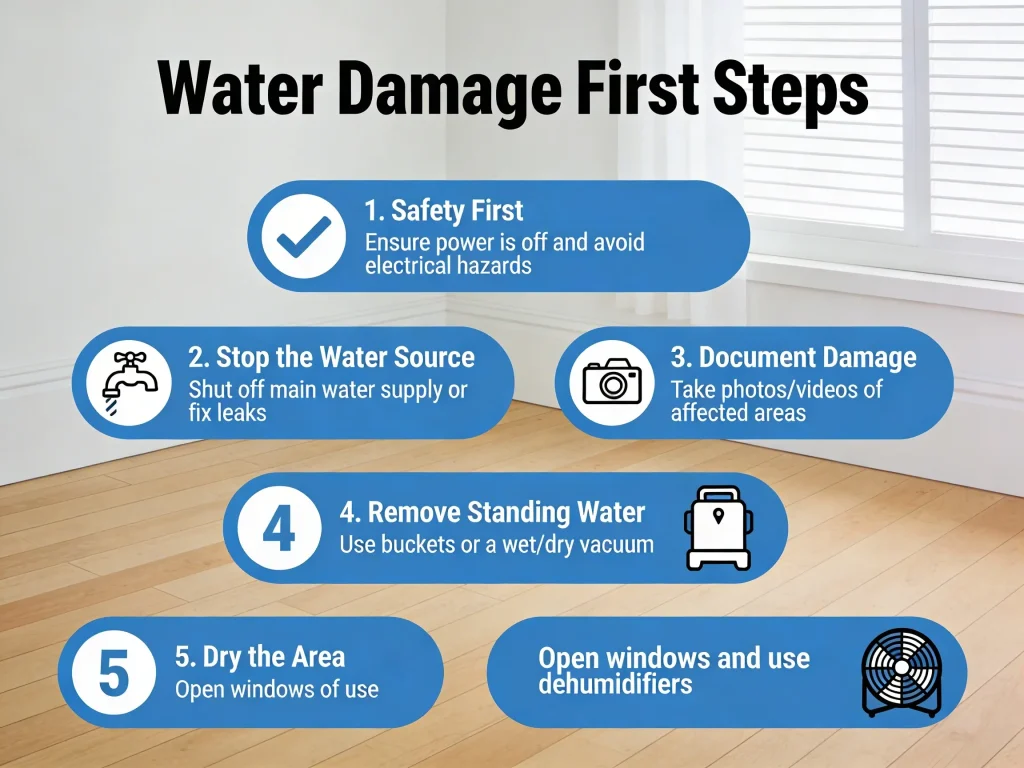
First steps after water damage
If it is safe to do so, these are the most useful first steps after water damage is discovered:
| Step | What to do | Why it matters |
|---|---|---|
| 1 | Stop the source of water if possible | Active water can continue spreading into materials and increase the amount of damage |
| 2 | Document visible damage with photos | This helps create a record of what was affected and when you noticed it |
| 3 | Move small belongings away from active moisture | This can help limit additional exposure to water |
| 4 | Check nearby materials for spread | Water often moves beyond the first visible area |
| 5 | Decide whether the situation needs a faster response path | Some water damage situations become harder to manage when action is delayed |
Stop the water source if it is safe
If water is still active, the first practical move is usually to stop the source. That may mean shutting off a fixture, appliance line, toilet supply, sink line, or the main water supply if the issue is coming from a plumbing failure. If the source appears connected to roof penetration, storm entry, or a ceiling leak, the immediate focus may be limiting indoor spread and protecting the area below.
If you are dealing with a plumbing failure, you may also want to read What to Do After a Burst Pipe.
Document what you can see
Take clear photos of affected areas as early as possible. Try to capture flooring, walls, ceilings, baseboards, trim, furniture, and any visible pooling, staining, swelling, or material distortion. If the damage is spreading, take photos from more than one angle and note what rooms or surfaces are affected.
Documentation does not solve the moisture problem, but it helps preserve a clearer record of the situation.
Move small items away from active moisture
If the area is safe, remove loose items that are directly exposed to water. This may include rugs, storage bins, small furniture, electronics, boxes, or fabric items near the wet area. The goal is not a full cleanup at this stage. The goal is simply to reduce additional exposure where possible.
Look beyond the obvious surface
One of the biggest mistakes after water damage is assuming the problem begins and ends with what you can immediately see. In reality, moisture can move under flooring, behind baseboards, through drywall, and into concealed areas. That is especially true after overflows, plumbing leaks, ceiling leaks, and longer-duration moisture exposure.
Signs that the damage may extend beyond the visible surface include:
- Soft or swollen drywall
- Buckling or lifting flooring
- Warped trim or baseboards
- Musty indoor odor
- Staining that keeps expanding
- Paint bubbling or peeling
- Ceilings that look sagged or uneven
If you want to understand this better, read Signs of Hidden Water Damage.
Do not assume visible drying means the issue is over
Some surfaces can appear drier while deeper materials still hold moisture. A floor may feel less wet while underlayment remains damp. A wall may no longer look soaked while moisture is still present behind paint, inside insulation, or around framing cavities. This is one reason some water damage problems continue after the initial event seems to be over.
If moisture remains too long, additional issues can become more likely. You can read more about that in How Fast Mold Grows After Water Damage.
What not to do after water damage
Some responses create more confusion or make it harder to understand what is really happening. Try to avoid these common mistakes:
- Do not wait too long if water is still active or still spreading
- Do not assume a dry-looking surface means deeper layers are dry
- Do not ignore ceilings with stains, bulging, or soft spots
- Do not leave wet rugs, towels, cardboard, or porous materials sitting too long
- Do not throw everything away before documenting visible damage
- Do not keep reading endlessly if the issue clearly needs a faster next step
When the situation may need a faster response
Some water damage situations are more time-sensitive than others. A faster next step often matters more when:
- Water is still entering the property
- There is standing water inside the home
- Multiple rooms are affected
- Ceilings, walls, or flooring are actively deteriorating
- The issue involved a burst pipe or major overflow
- You suspect moisture has reached hidden structural areas
If the issue is active or spreading, use the Request Help page instead of staying in research mode too long.
What happens next after the first steps
After the immediate first steps, the next question is usually what kind of response path makes sense. That depends on the source of water, how much material was affected, whether moisture is still active, and whether the damage appears limited or broader than first expected.
In many cases, users then move into one of these next-step categories:
- Water extraction when visible water or active pooling is present
- Water damage mitigation when early response and damage control are the priority
- Drying-focused next steps when materials remain damp after the initial event
- Location-specific pages when the user wants local relevance
Quick response guide by situation
| Situation | Immediate focus | Helpful next page |
|---|---|---|
| Burst pipe | Stop supply, document damage, assess spread | What to Do After a Burst Pipe |
| Ceiling leak | Protect area below, assess ceiling stability, document staining | Roof Leak Emergency Steps |
| Musty smell after a leak | Check for lingering hidden moisture | Signs of Hidden Water Damage |
| Concern about moisture timeline | Understand drying and moisture persistence | How Long Does Drying Take |
When to stop researching and act
Reading can help you understand the situation, but there is a point where continuing to research is less useful than taking the next practical step. If water is still active, if staining is spreading, if materials feel soft, or if the damaged area keeps expanding, it usually makes sense to move forward instead of waiting.
Final takeaway
If you are wondering what to do after water damage, start simple: make the area safer, stop the water source if you can, document what you see, move exposed items away from moisture, and look beyond the most obvious surface. Then decide whether the issue needs a faster response path.
If the situation is active or you do not want to leave it unresolved, use the Request Help page to move toward the next step.
Need help now?
If the guide matches your situation and you need to act quickly, use the request page to take the next step.